
How to go beyond basic descriptions in a new language
Make your Spanglish more colorful



At this time of the year, as summer is starting (in the northern hemisphere), there’s usually a change in pace, with holidays planned, more time spent outdoors and a break from obligations. For this reason, we’re in summer mode at Stress-free Spanglish too.
El año pasado, ofrecimos un reto con propuestas creativas para quienes quisieran seguir practicando inglés o español durante el verano, de manera divertida y flexible. La respuesta fue muy positiva, así que queremos aprovechar estos meses para invitarte a experimentar con otras formas de practicar idiomas y probar algunas de esas ideas. Sobre todo porque muchos disfrutaron las consignas sobre arte del mes anterior, que también tenían ese toque creativo.
In last week’s poll, we asked you which new topic you wanted to focus on. The options were from the summer challenge. Thanks a lot for your responses. They’re always very valuable to us.
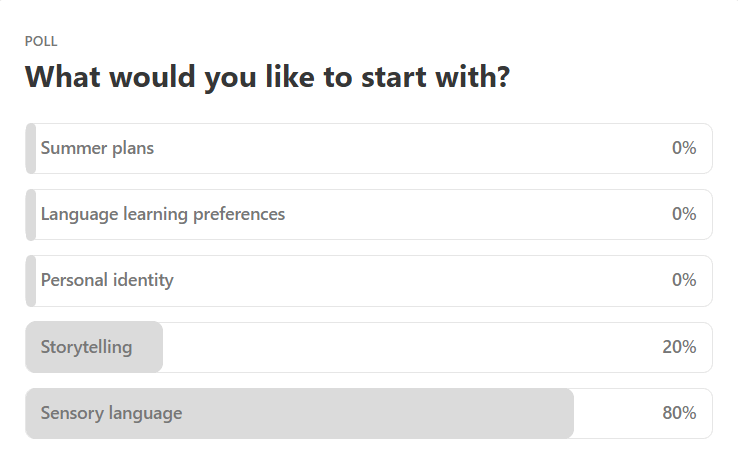
Only two options were chosen out of the five - storytelling by twenty percent of respondents and sensory language by the majority (eighty percent).
La propuesta creativa de esta semana consiste en escribir una entrada de diario sensorial. Aunque a menudo se recomienda llevar un diario para practicar idiomas, no siempre es fácil saber qué escribir o cómo ir más allá de una simple lista de actividades. Un diario sensorial te ayuda a encontrar ese punto de interés: te detienes en los detalles de tu día (o de un momento especial), conectas con tus sentidos y eso te lleva a usar un vocabulario más descriptivo y vívido en lugar de términos vagos.
It’s a three-step process. The first stage involves using divergent thinking to help with the creative process - brainstorming and exploring various ideas, without worrying about the language used or accuracy. The second stage, convergent thinking allows you to build on your original ideas and become aware of the sensory details from the important moments of your day. The third and final stage is the editing one, in which you bring together your original ideas with the sensory information and refine your language use.
Hay más actividades del reto que queremos compartir, pero en vista del interés por el lenguaje sensorial en la última encuesta, nos encantaría saber: ¿prefieres seguir profundizando en este tema o probar otro tipo de consigna creativa?
We hope you enjoy writing your sensory diary and are looking forward to hearing what you come up with both in the coffee chat and here in the comments. Please feel free to share anything you feel comfortable with, or let us know if you found it useful. We’re also keen to discuss the five senses further with you in the coffee chat. It’s a great opportunity to practise expressing your personal preferences and perspectives, describing special memories and internal experiences, plus using sensory language and descriptive vocabulary in a conversational way.
Para practicar
Si quieres prepararte para el coffee chat o simplemente practicar un poco la escritura, aquí tienes algunas consignas que puedes usar en una sola sesión o a lo largo de la semana, según te convenga.
If you’d like to prepare yourself for the coffee chat or simply practise your writing a little, here are some prompts you can use in a single sitting or spread them out over the course of the week, as suits you best.
Antes de escribir, tómate un momento para reflexionar sin preocuparte por el idioma.
Before starting to write, take some time to reflect without worrying about the language.
Piensa en tus experiencias en un día cualquiera, desde que te despiertas hasta la hora de dormir. Si lo deseas, puedes apuntar los momentos clave de tu rutina.
Think about your experiences on an average day, from the moment you wake up until bedtime. If you wish, you can jot down the key moments of your routine.
Vuelve a pensar en esos momentos e intenta identificar los detalles sensoriales.
Think back over those moments and try to identify the sensory details.
¿Qué colores, formas o imágenes sueles ver?
What colours, shapes, or images do you usually see?
¿Qué oyes en cada momento? ¿Música, voces, ruidos, silencio?
What do you hear at each moment? Music, voices, sounds, silence?
¿Qué olores notas? ¿Comida, perfumes, naturaleza?
What smells do you notice? Food, perfume/fragrances, nature?
¿Qué texturas, temperaturas o sensaciones físicas sientes?
What textures, temperatures, or physical sensations do you feel?
¿Qué sabores son recurrentes? ¿Té, café, algún cítrico?
What flavours recur? Tea, coffee, some kind of citrus flavour?
Reflexiona sobre cómo cambia la manera de hablar de tu día al añadir este tipo de detalle. ¿Se vuelve más específica, vívida, variada?
Reflect on how the way you talk about your day changes when you add this type of detail. Does it become more specific, vivid, or varied?
En la siguiente sección encontrarás algunas estructuras que pueden ayudarte a desarrollar tus ideas. Puedes usarlas para escribir a tu ritmo y según tus preferencias:
In the next section, you’ll find some structures that can help you to develop your ideas. You can use them to write at your own pace and in line with your preferences:
Un día: escribe una entrada de diario enfocada en los cinco sentidos (puede ser sobre un día específico o sobre un día típico en tu vida).
One day: write a diary entry based on the five senses (it can be about a specific day or a typical day in your life).
A lo largo de la semana: enfócate en un sentido cada día. El sexto día, vuelve a leer lo que has escrito para elegir tus partes favoritas y editar la versión final de tu texto.
Throughout the week: focus on one sense each day. On the sixth day, reread what you have written, select your favorite parts and edit the final version of your text.
En presente o en pasado: puedes hablar sobre tu rutina en presente o elegir un recuerdo para hablar de esa experiencia de manera más descriptiva.
In the present or past: you can talk about your daily routine in the present tense or choose a memory and describe that experience in greater detail.
A continuación encontrarás estructuras en presente y en pasado para que puedas elegir cuál usar, dependiendo de si se trata de un día típico en tu vida o de un recuerdo.
The structures below are in present and past form, so you can choose which one to use, depending on whether it’s a typical day in your life or a memory.
La escena / The scene
Es/era un día… y yo estoy/estaba en…
It is/was a… day and I am/was in…
El cielo está/estaba…
The sky is/was…
Hay/había un olor a…
There is/was a smell of…
Se oye/oía…
The sound of… can/could be heard.
Percepciones / Perceptions
Veo / Vi…
I can see… / I could see…
Oigo / Oí…
I can hear… / I could hear…
Huelo / Olí…
I can smell… / I could smell…
Pruebo/Probé - Saboreo/saboreé …
I can taste… / I could taste…
Siento / sentí…
I feel… / I felt…
Características / Characteristics
Los colores son/eran [intensos/oscuros/claros/ vivos/apagados/suaves/tenues]...
The colours are/were [intense/dark/light/bright/dull/soft/faint]…
Hay/había una luz [directa/ tenue/media/cálida/brillante]...
There is/was a [direct/dim/faint/medium/warm/bright] light…
Escucho/escuché un sonido [fuerte/débil/lejano/intermitente/repetitivo]...
I can hear a [loud/faint/distant/intermittent/repetitive] sound/noise...
Hay/había un olor [dulce/floral/cítrico/ fresco/penetrante/repugnante]...
There is/was a [sweet/floral/citrus/fresh/pungent/revolting] smell…
Tiene/tenía un sabor [dulce/salado/ácido/amargo/picante/agrio]...
It has/had a [sweet/savoury/salty/acidic/bitter/spicy/sour] taste…
Sensaciones y recuerdos / Sensations and memories
Ese [olor/sabor/sonido/etc.] me recuerda a...
This [smell/flavour/sound/etc.] reminds me of…
Cada vez que [siento/huelo/escucho/etc.]..., pienso en...
Each time I [feel/smell/hear/etc.]..., I think of/about...
Me produce/produjo una sensación de...
It gives me the sensation of...
Una última revisión / Final check
Vuelve a leer tu texto. Juega con el equilibrio entre la narración (tomé café) y la descripción sensorial (sentí el toque amargo del café caliente), así como entre los distintos sentidos.
Read your text again. Play around with the balance between narration (I drank coffee) and sensory description (I tasted the bitterness of the hot coffee), as well as between the different senses.
Busca las palabras que no conozcas, añade o cambia lo que haga falta y asegúrate de que las ideas se conecten de manera lógica.
Look up any words you aren’t familiar with, add or change anything that’s needed and make sure that your ideas connect together in a logical way.
Bonus prompt
Hoy es el Día Mundial de la Música. Pon tu canción favorita en el idioma que estés aprendiendo y presta atención a los detalles sensoriales de la letra. ¿Qué imágenes, sonidos, texturas o sabores aparecen?
Today is World Music Day. Play your favorite song in the language you are learning and pay attention to the sensory details in the lyrics. What images, sounds, textures, or flavors appear?
☕ Join our next Spanglish Coffee Chat
Topic: Sensory language
Date: Wednesday, 24th June at 12:00 pm ET / 5 pm UK
Spaces: Limited to 6
Entrance fee: A donation of your choice
** You can decide how much you’d like to donate, but your card issuer might require a small minimum amount, such as £1. **