
Languages are social... even in an AI-driven world
The value of learning with others



This week, we’re starting our new monthly theme about community language learning, which is one that’s close to our hearts. The English-Spanish coffee chats that formed the basis of Stress-free Spanglish began purely for ourselves, as a way for us to practise both languages together in a relaxed, non-judgemental way. Just to give those of you who don’t know us some background, we’re Bianca and Mary from Stress-free Spanglish. We’re both language teachers and learners. Bianca is a Spanish teacher from Venezuela, living in Uruguay, as well as being an English and French learner. Mary is an English teacher from the UK and a Spanish learner. We’ve both lived abroad and had to navigate life in our second language and it remains a big part of our lives.
Tras algunos meses reuniéndonos, decidimos abrir nuestros coffee chats a otras personas. Poco después, empezamos este boletín con el propósito de ayudar a quienes quisieran prepararse para las sesiones (puedes leer más aquí). En este tiempo, hemos recibido tanto apoyo como el que hemos brindado; hemos comprobado los beneficios de sostener un espacio de aprendizaje con intención, pero sin estrés; y, más aún, hemos sido testigos de los vínculos que se han forjado entre tantos de nosotros. Por eso, no nos sorprende oírlos referirse a lo que tenemos aquí como una ‘comunidad’. Nosotras también lo sentimos así y creemos que es un buen momento para preguntarnos (y preguntarte) qué queremos decir realmente por ‘comunidad’ y de qué manera nos gustaría que este espacio contribuyera a nuestra práctica y metas de idiomas.
The concept of community in language learning isn’t a new phenomenon. Before the internet age, this method was utilised in language classrooms, making lessons more learner-centred and communicative, being structured around topics that students want to learn and discuss, incorporating translation into the process. You can read more about the traditional community language learning classroom-based approach here.
Hoy en día, con el internet, es frecuente usar ‘comunidad’ para referirse a suscripciones que brindan acceso a plataformas privadas y/o a eventos en los que los miembros pueden participar e interactuar. Ese tipo de membresía también existe en el ámbito del aprendizaje de idiomas. Sin embargo, queremos invitarte a pensar más allá de esta definición y a reflexionar sobre qué te permite sentirte parte de un espacio de encuentro con otros y qué diferencia para ti una comunidad de un grupo.
We’re really interested in exploring this notion of community language learning further. Self-study is common and very easy to do these days, with so many online language resources and apps, plus AI being able to generate infinite grammar and vocabulary activities. However, we shouldn’t underestimate the unique value of interacting with other people. Language learning isn’t just about memorising grammar rules, learning vocabulary and perfecting pronunciation, it’s a social function, with communicating with other people being at its core.
No es cuestión de elegir entre una cosa y la otra. Tanto las actividades de aprendizaje por cuenta propia como las comunidades tienen su lugar. Se trata de comprender el propósito de cada modalidad y lo que podemos esperar en cada caso. Por ejemplo, estudiar solos nos permite exponernos a grandes cantidades de input, observar la lengua a nuestro propio ritmo y prepararnos para ciertas situaciones comunicativas. Por su parte, la interacción humana (ya sea síncrona o asíncrona, oral o escrita) es el corazón de la comunicación misma y, como tal, presenta otras oportunidades y desafíos.
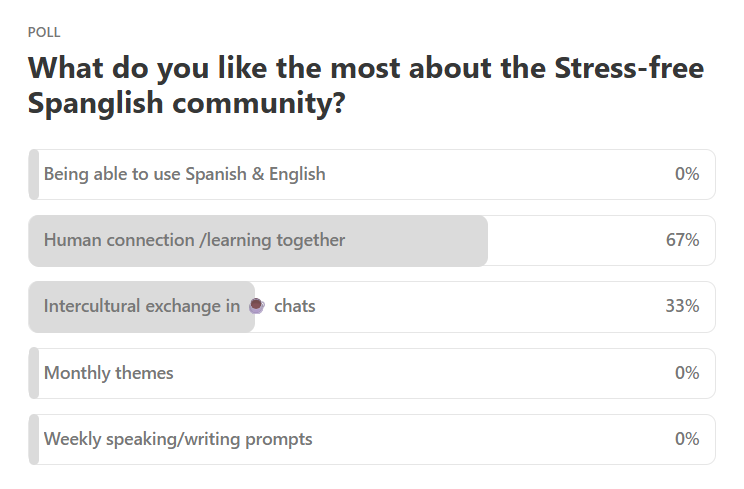
The importance of human connection and learning together is evident from last week’s poll, in which two thirds of respondents chose this as the aspect of the Stress-free Spanglish community they like the most. Intercultural exchange in the coffee chats was also considered to be most important by one third of those who took part. These are precisely the types of things that AI can’t replace.
In the upcoming coffee chats and newsletter editions, we’re eager to dig deeper into what we seek out and can gain from human encounters and spaces. It’s a month in which to explore these questions together and try simple things to foster the human connection that benefits our language goals and cultural enrichment, as well as sharing our experiences and points of view. Now, being summertime (in certain parts of the world), it’s the perfect time to try new things and come together.
Ya sea que nos leas semana a semana, que uses las consignas para practicar por tu cuenta o que nos acompañes en los coffee chats, tu participación es valiosa y contribuye a darle vida a este proyecto. Por eso, nos interesa conocer tu opinión sobre este tema.
Para practicar
Si quieres prepararte para el coffee chat o simplemente practicar un poco la escritura, aquí tienes algunas consignas que puedes usar en una sola sesión o a lo largo de la semana, según te convenga.
If you’d like to prepare yourself for the coffee chat or simply practise your writing a little, here are some prompts you can use in a single sitting or spread them out over the course of the week, as suits you best.
Reflexiona sobre lo que significa para ti aprender un idioma en comunidad.
Reflect on what learning a language as part of a community means to you.
Piensa en aspectos como:
Think about aspects like:
Las ventajas de aprender un idioma en comunidad frente a estudiarlo por tu cuenta.
The advantages of learning a language as part of a community compared to self-study.
El valor de la conexión humana y el intercambio cultural más allá de la práctica de idiomas en sí misma.
The value of human connection and cultural exchange beyond the language practice itself.
Las diferencias entre las comunidades en línea y las presenciales (y qué te hace permanecer en las comunidades de las que formas parte).
The differences between online and in-person communities (and what makes you stay in the communities you’re a part of).
Tómate un momento para reflexionar sin preocuparte por el idioma. Luego, organiza tus ideas. En la siguiente sección encontrarás algunas estructuras que pueden ayudarte a desarrollarlas.
Take some time to reflect without worrying about the language. Then, organise your ideas. In the next section, you’ll find some structures that can help you to develop them.
Solo(a) o en compañía / Alone or in company
Por mi cuenta, puedo…, pero no puedo… sin otras personas.
I can do… by myself, but… isn’t possible without other people.
Puedo ayudar a otros a…
I can help others to / with…
Ayudar a otras personas también me permitiría…
Helping other people would also give me the chance to…
Me gustaría encontrar un espacio en el que…
I’d like to find a space where…
Creo que todos podemos aprender cuando…
I think we can all learn something when…
Lo que valoro / What I value
Me siento parte de una comunidad cuando…
I feel part of a community when…
Lo más valioso de aprender con otras personas es…
The most valuable thing about learning with other people is…
Conocer otras perspectivas me ayuda no solo a…, sino también a…
Learning about other perspectives helps me not only to…, but also with…
Lo que me resulta más motivador es…
The thing I find most motivating is…
Actualmente, formo parte de una comunidad/comunidades que… Por ejemplo,...
I’m currently part of a community/communities that… For example,...
Para mí, una comunidad de aprendizaje de idiomas debería ofrecer…
In my opinion, a language learning community should offer…
En línea o en persona / Online or in person
Los encuentros [en línea / en persona] permiten…
[Online / in-person] meetings give you the chance to…
El formato [presencial / virtual ] facilita/promueve… En cambio…
The [in-person / virtual] format promotes/encourages… Whereas…
Se me hace más fácil participar en comunidades [presenciales / virtuales] porque…
I find it easier to take part in [in-person / online] communities because…
Personalmente, prefiero las comunidades [en línea / en persona] porque…
Personally, I prefer [online / in-person] communities because…
Mi comunidad ideal / My ideal community
Escribe las reglas de tu comunidad de aprendizaje de idiomas ideal:
Write down the rules for your ideal language learning community:
Esta comunidad se basa en… y el objetivo es…
This community is based on… and the goal is…
En este espacio se puede…
You can… in this space.
No está permitido…
… isn’t allowed.
Una última revisión / Final check
Busca las palabras que no conozcas, añade o cambia lo que haga falta y asegúrate de que las ideas se conecten de manera lógica.
Look up any words you aren’t familiar with, add or change anything that’s needed and make sure your ideas connect together in a logical way.
☕ Join our next Spanglish Coffee Chat
Topic: Community language learning
Date: Wednesday, 29th July 12:00 pm ET / 5 pm UK
Spaces: Limited to 6
Entrance fee: A donation of your choice